
The cold north wind whipped against Seidrun's cloak, but she barely felt it anymore. Life on the Norwegian coast had hardened her from childhood, and the wind, once a biting enemy, had become a familiar companion—like an old friend. Her world was governed by the tides and the sky. Daughter of a noble warrior, mother of two small sons, and wife to a man often away at war, Seidrun was a woman whose life was shaped by duty. Yet, deep within her, there was a fire that refused to be extinguished.
Seidrun was not like the other women of her village. Her dreams stretched beyond the hearth, beyond the fields, beyond the narrow world that society had carved out for her. While most women of her time were confined to their roles as wives and mothers, maintaining the home while the men fought and traveled, Seidrun longed for something more. She was captivated by the stories of Viking women who had defied their expected roles—shieldmaidens who had fought alongside men, who had earned their place in the sagas, not by their wombs but by their swords.

As she worked in the fields outside the longhouse, her hands full of wet grass and soil, her gaze kept drifting toward the endless sea. The horizon called to her in a way she could never explain. She had heard tales of women like Freydís Eiríksdóttir and Lagertha, women who had stood side by side with men on the battlefield and sailed across oceans to unknown lands. Such stories filled Seidrun with an aching yearning, a desire to break free from the invisible chains that bound her to her life as a wife and mother.
"Seidrun!" her mother’s sharp voice pulled her from her reverie. Astrid stood with hands on her hips, a stern look on her face. "Daydreaming again. Your children are waiting inside, and there is much to do before winter sets in."
Seidrun sighed but nodded. She was not only a mother but also responsible for much of the farm’s work while her husband, Sigvald, sailed with the king’s warriors. Life for a Viking woman was rarely easy. Women managed the household, oversaw the farm, and often held great influence within their families, yet there was still a chasm between what women could do and what men were allowed to accomplish.
But the fire inside Seidrun would not be easily extinguished. As she cared for her sons and prepared for the coming winter, her thoughts continued to circle back to Sigvald’s letters. He wrote about his travels to distant lands—great markets in Miklagard (modern-day Istanbul), the rich cities of England, and the vast unknown seas. Why should men have all the glory? Why couldn’t a woman also travel and see the world with her own eyes?
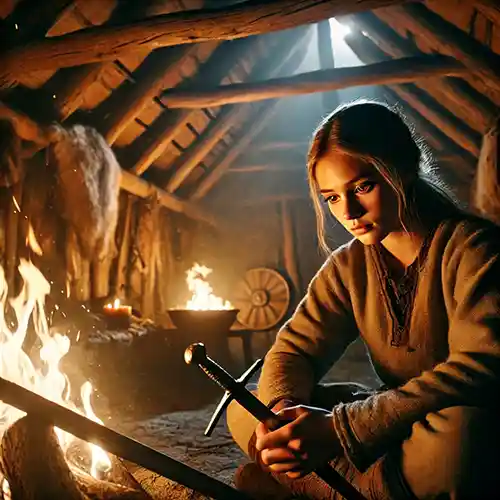
That night, as the darkness fell over the village, Seidrun sat alone by the hearth. The flickering flames cast dancing shadows across the room, but her mind was elsewhere—lost in the adventures Sigvald had described. His letters were full of battles, of strange lands and foreign people. There was a restlessness in her heart that no fire could warm. The world was changing, and Seidrun knew she could not remain a passive observer.
She rose from her place by the fire, feeling an unfamiliar surge of determination. Quietly, she walked to the corner of the room and opened an old chest. Inside lay two things she had not touched in years—a shield and a sword, both belonging to her father, a warrior who had fought bravely before falling at the battle of Hafrsfjord.
The shield was heavy, and the sword was still sharp. Seidrun gripped the hilt, feeling its weight in her hand. This was more than just a weapon—it was a symbol of her heritage, her identity. Her father’s words echoed in her mind: "A woman can carry a shield as proudly as any man. It is the heart, not the gender, that makes a warrior."
The wind howled outside, but inside, the fire burned brighter. Seidrun knew that the road ahead would not be easy. It would be filled with challenges, with dangers she could not foresee. But the thought of remaining confined to the life she had known, of never seeing the world beyond her village, was a greater fear than any storm or battle.
Before dawn, she made her decision. She would leave. Her children would be cared for by her mother, and she would seize the opportunity to live the life she had always dreamed of. There was a ship set to sail for England in the morning—a Viking ship, bound for the rich lands across the sea. This was her chance.
Without hesitation, she made her way down to the harbor. The captain, a grizzled man named Torvald, watched her approach with a raised eyebrow. He did not often see women like Seidrun so far from their hearths.
"What does a woman like you want aboard my ship?" he asked, his voice rough but not unkind.
Seidrun met his gaze, her resolve firm. "I wish to see the world. Let me show you that I belong here."